knowledge provider

- A
- A+
- A++

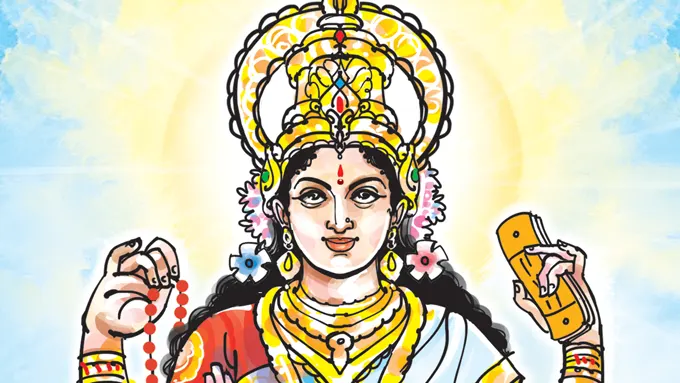
SaRaswati Brahmashakti- Wisdom for creation, speech Consciousness that imparts meaning and wisdom to the human mind. Mula Nakshatra is special in Dussehra Navratri as it is the auspicious time when Goddess Jagan appears who lights the lamp of knowledge called Sadbuddhi. 'Moola' means the base of the entire universe. This Nakshatra is most suitable for invoking the form of ShabdaBrahma, the source of knowledge. Legend has it that at the beginning of creation, Lord Brahma worshiped the goddess in this star to gain knowledge.
Mulamurthy of all arts... Goddess Saraswati. Rugveda says 'Ambitame Naditame Devitame Saraswati'. It means divine in mothers, rivers, gods. The form of Saraswati is the basis of life consciousness, knowledge and flow of speech in a living being. In the famous 'Vaksuktam' of the Rugveda, Vagdevate himself states that I am present in all beings and all gods in the form of self-consciousness. Apart from imparting worldly knowledge, this 'speech' is a great power that awakens the dormant truth, consciousness and wisdom within.
The names of Goddess Saraswati mentioned in Devi Bhagavatam, Brahmavaivarta Purana and Lalita Sahasranama have great implications. As 'Sharada' she is an ignorant heathen. All Vedic science is given as 'Bharati'. The names 'Vallaki' and 'Sumukhi' are blessed with truthful, beautiful and sadhu sounding speech. The concepts of 'Mahasveta' and 'Svetambara' suggest the spiritual purity of Sattvaguna Samanvita. The forms of 'Haripriya' and 'Virinchipriya' appear as the source of the will of creation. The names of 'Bhaswati' and 'Prajnaparamita' stand out as great addresses to awaken discernment in the human consciousness.
Saraswati's external figurative form is a set of mysterious symbols that lead human minds to the transcendental state. Even though man is living in worldly ignorance, the 'white lotus' symbolizing the spiritual wisdom to rise above the ugliness of pride and lust. Blooming lilies represent expansion of knowledge and consciousness. While the 'book' worn by Jagajjana represents the storehouse of worldly and transcendental knowledge, the 'rosary' guides the introspective journey, the concentration of the sadhaka's mind, and the pursuit of self-realization. Hamsa Tattva reminds us to abandon falsehood and embrace only true knowledge.
True education is what frees the soul from the bonds of ignorance and all sufferings forever. Behind Lord Rama's appreciation of Hanuman's unique grammar skills, the implication behind Dharmaraja's test of knowledge through Yakshaprasana is to prove that education is a practice of consciousness with wisdom and righteous wisdom. Auspicious time of Dussehra Navratri- The real nirjana we offer to Goddess Jagan is to remove our ignorance and pride and spread the light of knowledge to all!
► Read latest Editorial Newsand Telugu News► Follow us on Facebook, Twitter, Instagram& Google News. Tags :Note:Business advertisements appearing on Eenadu.net are different It comes from businessmen and organizations in countries. Some ads are sent with artificial intelligence based on the reader's preferences. Readers should exercise due care and make appropriate inquiries about products or services before purchasing. The respective products/ OWNER TODAY IS NOT RESPONSIBLE FOR THE QUALITY OR ERRORS OF THE SERVICES. There is no room for correspondence in this matter.
More
- Rich. Like the shadow of a man in the journey of life, survival and hope travel together. There are many needs and desires that arise in the mind of man that are not found in any creature in creation. It is not easy to get rid of them. When they are insatiable desires, the Arishadvargas like sorrow and anger arise and lead the man towards suffering.
- Mental evolution A small plant is worthwhile only when it grows into a great tree and bears fruit and gives shade to the weary. The full moon entertains the moon only when the moon gradually increases in strength and attains perfection.
- Shrama is divine. Every creature in the creation gets happiness only through labor. That's how we can achieve anything in life. Labor is not just physical hardship. A penance, a yajna, the path to liberation. Bhagirath is the definition of hard work. Sagara decided to bring Ganga down to earth for the salvation of his sons. He did penance for thousands of years and pleased Brahma.
- Secret of two fingers There are many stories to tell how much Krishna loves the gopis. But the story of Balakrishna, who was bound by Yashodamma's love, hides a unique spiritual message.
- Journey to Success It's time for Amma's festival. This Mother - Mother of all Mothers, the glorious month of spreading her grace - Asvayuzam.
- Eternal resolution. Whenever we start any auspicious activity including Nitya Puja, we say 'Dharmartha Kama Moksha Chaturvidha Purushartha Phalasiddhyrtham'. It is a great way of life which reminds us daily of the four sutras necessary for man to achieve a perfect life.
- Tasmai Sri Tharuve Namah Indians have the philosophy of visiting the divinity in the nest of the tree. The hymn 'Mulato Brahmarupaya Madhyato Vishnurupine Agratasshivarupaya' explains that the root of the tree is for Brahma, the middle for Vishnu and the tip for Sadashiva.
- Prakriti - Purusha Even the Creator cannot create without an accompanying power. Jagadguru Adisankaracharya in the very first verse of his 'Saundaryalahari'... has expressed the absolute truth that even Shiva can continue creation when he has power, and without that power he cannot even move.
- The first step to the fall. Jealousy is a small pollution that starts in the mind. It is not visible on the surface but destroys the man from within. Jealousy is not being able to rejoice at one's happiness, not being able to bear seeing one's growth.
- Gurukrupa Guru is the philosophical embodiment of the Trinity. Ishwar and Guru are different in appearance but the soul is one. Even if the beliefs, policies and teachings of Sadhguru are different, their goal is welfare of the world. Their mission is to lead people from ignorance to knowledge, from death to immortality.
- Silent friend. A wonderful mantra in Mundakopanishad reveals the greatest truth of our life.
- The destination is the same! 'Spirituality' is a very broad concept. It cannot be limited to a definition, specific customs and traditions. Basically, the spiritual journey is personal. Hence, it is crucial to choose a path that suits the nature.
- The Hanging Man Some fables told by elders make deep philosophical truths easy to understand.
- Ahimsa Paramo Dharmah Mahabharata says 'Ahimsa paramo dharmasthathahimsa paro damah/ Ahimsa param dana mahimsa param tapah'. It says that non-violence is the supreme virtue and there is no penance beyond that.
- Discretion Discernment is not only a matter of intellect, but an inward spiritual power…. That wisdom is needed to face life's challenges.
- Praises Everyone tries to gain worldly approval. There are few people who are not squeamish about praise. Some kiss those who praise them for their own gain - others indulge themselves!
- Jada Bharata Spiritual practice is not enough simply to stay away from the external world. The desires of the mind and mamkara should also be conquered. Bharata rules righteously and eventually leaves the kingdom to do penance in the forest.
- Scriptures Navneetham means butter. This is a simple meaning. When it is added as an adjective to any Bhagavata text and says 'Bhagavata Navaneetham' - Nava means 'fresh' and Neetham means 'Amrit brought to the earth', the adjective comes out.
- Vijayathiras Success in life is not a sudden stroke of luck. It is the result of the decisions we make continuously.
- Jitendriyas Joys and sorrows are impermanent. It is futile to worry about them. Even in the world of material odors, those who cling to them are jitendriyas. It means, those who have conquered the senses.


