
Aggression in trade deals!
alt="Eenadu icon" class="img-fluid rounded">By Editorial Team Published : 24 Dec 2025 03:05 IST Ee Font size - A
- A+
- A++
4 min read

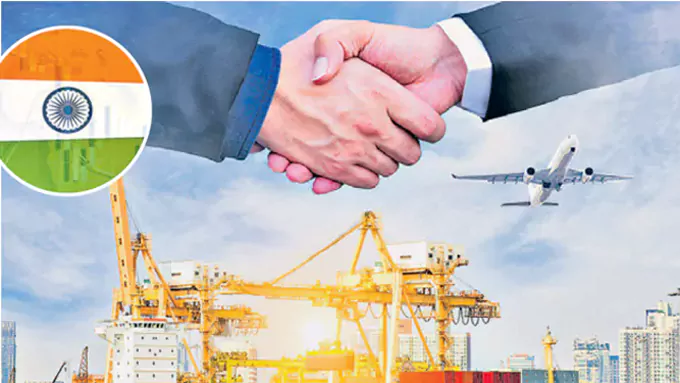
India, which has become the fourth largest economy in the world, is eager to rise another step in the next two years. It aspires to be a 'developed nation' by 2047. For this, the Center has brought in GST 2.0 reforms domestically and is aggressive in entering into Free Trade Agreements (FTAs) with various countries.
Fortwo or more countries enter into FTAs between themselves to completely eliminate and significantly reduce tariff and non-tariff barriers in trade in goods and services. It includes aspects like investment protection, intellectual property rights and dispute resolution mechanisms. FTAs- reduce burden on exports and imports. A level playing field in international markets. It helps in getting raw materials at low tariffs. Traders will benefit from this. Currently, there are more than 350 FTAs in force around the world. These agreements are beneficial not only in terms of tariffs but also strategically. These are useful for increasing foreign investment and improving job creation. It helps to withstand fluctuations in international markets. That's why- the Center has been focusing exclusively on FTAs for several years. Our country has concluded FTAs with Japan, South Korea, Britain and other countries as well as associations like ASEAN. The agreement was signed with Oman last week. A recent FTA with New Zealand has also been finalized.
Benefit for domestic industries
FTAs are the cornerstones of India's economic strategy. These will help our country to be deeply integrated in international supply chains. It helps to increase the strength of exports and the number of export markets. With FTAs already in place – Indian products and services are getting duty-free and sometimes low-duty access in some foreign markets. Due to this, industries like textile, agriculture, leather and engineering products, which require a lot of domestic labour, are benefiting. Free Trade Agreements will significantly increase bilateral trade with the respective countries. Britain and India have agreed to double bilateral trade by 2030. For this, they have signed an FTA named 'Comprehensive Economic and Trade Agreement (CETA)'. With CETA, 99% of Indian products have duty-free entry into the UK. Due to this, Indian products are able to compete with manufacturing hubs like China and Vietnam.
The 'Trade and Economic Partnership Agreement (TEPA)' signed by India with the European Free Trade Association (EFTA) came into force from October this year. It helps to completely eliminate tariffs on 99.6 percent of Indian products in Switzerland, Norway, Liechtenstein and Iceland. The deal will help create one million direct jobs in India over the next fifteen years.
To withstand the downturn...
India's exports grew by 15.52 percent last month (compared to a year ago) to $73.99 billion. Imports were almost flat at $80.63 billion. As a result, the trade deficit decreased by 61 percent and was recorded at 6.64 billion dollars. US tariffs are disturbing many countries. endangering the sustainability of supply chains. Superpower President Trump also slapped tariffs on Delhi for buying crude oil heavily from Russia. However, our economy has performed well. FTAs help to deal effectively with international uncertainties. India is trying hard to conclude FTAs with countries like USA, Chile, Peru and Israel along with EU. Due to competition in the international market, there is a threat of pressure on domestic traders in sectors like milk, oil and seeds. So, India is taking steps towards formalizing FTAs while reassuring them. Negotiations with many countries have reached the final stage. If they work - India will be able to withstand the ups and downs of the international financial sector more effectively. Foreign companies will come forward to set up manufacturing units in the country to reap the benefits of the FTA. Indians will have access to a wider variety of Melimi products at lower prices. The quality of indigenous products will also improve. Realization of 'Vikasit Bharat' will become easier.
Many sportspersons are taking banned stimulants out of greed to win medals anyway. Some people are using doping drugs as a source of treatment. Between 2021-24, 640 players in India failed doping tests. If in 2021 there were 42 dopes, by 2024 their number will increase to 260. Among the sportsmen caught in doping tests in four years are those of the respective disciplines...

Note:Business advertisements appearing on Eenadu.net are different It comes from businessmen and organizations in countries. Some ads are sent with artificial intelligence based on the reader's preferences. Readers should exercise due care and make appropriate inquiries about products or services before purchasing. The respective products/ OWNER TODAY IS NOT RESPONSIBLE FOR THE QUALITY OR FAILURES OF THE SERVICES. There is no room for correspondence in this regard.


